

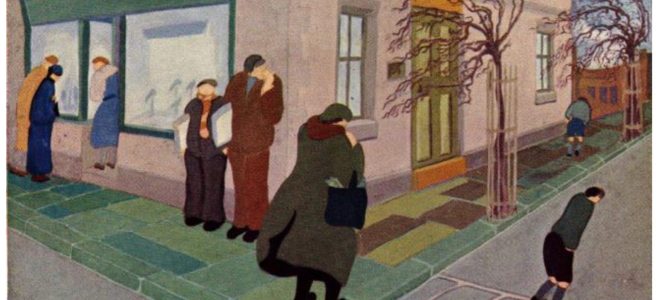
The Ashington Group’s permanent collection is now housed at the Woodhorn Museum which has recently been absorbed into the North East Museums group. In 1936 though they featured in an exhibition at the Hatton Gallery.
This is how it happened!
Twelve months ago I had no particular interest in art.
Today, Art Appreciation is an essential thrill of my life.
Harry Wilson, 1936
From the 16th – 21st November 1936, the Hatton Gallery held ‘An Exhibition of Paintings by Members of an Art Appreciation Group, Ashington, Northumberland’. This was in fact the first exhibition of the Ashington Group, a collective of working-class artists commonly known today as the ‘Pitmen Painters’.


The Ashington Group had formed on the 29th of October 1934 as an Art Appreciation class organised by the Workers Educational Association (WEA). A branch of the WEA had existed in Ashington since 1911, and beginning in the mid-1920s there had been interest amongst the branch committee in studying Art. In 1928, the Irish engraver Professor E. M. O’R Dickey, then principal of the King Edward VII School of Art, taught a year-long preparatory course on Art Appreciation in Ashington, which was reported to have been a ‘marked success’. The Ashington WEA committee wanted to renew the course for another year, but difficulties in securing another tutor and pushback from the WEA head office in Whitehall – who insisted that courses should keep to strictly theoretical subjects – meant that it took five years for this to materialise.
In 1934 the Ashington WEA finally secured a tutor for the class. Robert Lyon A.R.A., then Master of Painting at Armstrong College, was sent up to Ashington to teach the fortnightly classes. The sessions took place in a small wooden ex-army hut in the back yard of a cinema, lit by only a single bulb and heated by a small stove. Under these conditions, with the assistance of a slideshow projector, Lyon attempted to run through the last 500 years of European art. But many of the Ashington men showed little interest in Michelangelo, Rembrandt, or Velázquez. They wanted to be brought up to speed on the art of the present day. ‘The picture of Art in England at that time was a real puzzle’, explained Harry Wilson, dental mechanic and president of the local WEA; ‘so we thought we’d subject ourselves to that. We insisted it had to be Modern Art.’
Explaining Modern Art, however, to a class of men who largely had no background reading on the subject proved immediately challenging, as Wilson readily admitted: ‘Lyon could see, and he was quite certain, that any academic approach was going to be hopeless with us – we weren’t the sort of material to work on that way. He decided he’d make his own approach.’ This was an approach of ‘seeing by doing’; to gain an understanding of the artist through attempts to create art. Initially this too was met with trepidation, and Lyon described the first crop
of results as ‘rather depressing – Pierrots, Swiss lakes, and pretty girls’. But he persisted, and through further discussion and encouragement, the men overcame their apprehensions and allowed themselves to express themselves in paint. In doing so, many gained a fresh understanding and appreciation of both Modern Art and the modern artist.


In short time, the Ashington project attracted the attention of various prominent figures in the world of art. Wealthy heiress and art collector Helen Sutherland, then living at Rock Hall in Alnwick, not only started to purchase their work, but also paid for them to take a study trip to London where they visited the Royal Academy, the Tate, and the studios of painter Edward Halliday (a friend of Lyon’s) and renowned sculptor Alfred Hardiman. During visits to Rock Hall, the Ashington men were they were given exclusive access to Sutherland’s extensive collection of modern art, and met contemporary artists such as Ben Nicholson.
After two years of tutoring the Ashington men, Robert Lyon felt proud enough of what he had achieved with the class to arrange for their work to be exhibited publicly. The men of the class, few of whom really thought of themselves as artists, were naturally self-conscious about their works being on public view, and in some cases they even faced opposition from their wives who did not want to encourage any lofty pretensions. Lyon, though, was undeterred, and in November 1936 the Hatton Gallery – then part of Armstrong College – became the first venue through which the work of the ‘Ashington Art Appreciation Group’ would become visible to the public.
In total, 97 linocuts, sketches, and paintings by twenty-two members of the class – the youngest 24 years old, the eldest 80 – were selected for exhibition. The WEA did not have the budget for professional artists’ equipment, so most of the paintings were executed with whatever materials were readily at hand: plywood, paper stuck to card, or even inverted canvases recycled from old oil paintings. Walpamur, a cheap and widely available ‘water paint’ used for house painting, became the Group’s primary medium.
The subject matter mostly derived from generic titles set for the class by Lyon, such as ‘Spring’, ‘Winter’, ‘East Wind’, ‘The Hermit’, and ‘The Deluge’. But whilst Lyon had in many instances expected religious or allegorical interpretations, as perhaps he might get from his students at Armstrong College, instead many of the men had produced images of the things that were pertinent or relatable to their own lives in Ashington: Bedlington terriers, rowing clubs, pit ponies, and miners at work. What emerged therefore was not only an experiment in art appreciation, but an important visual record of the facts of work and leisure in a colliery town, recorded by members of the community.
The exhibition was opened on Monday 16th November by Sir William Sinclair Marris, then principal of Armstrong College. ‘I think this exhibition must be one of the most remarkable displays that have been shown in the gallery’, he opined. ‘This is not an exhibition of paintings by art students in the ordinary sense. In this course, the attainment of personal skill has been a subsidiary or even negligible object. The essential purpose has been something quite different – to arouse in every member of the art class an appreciation of art values through the practising of art itself.’
Though the Ashington Group would later become known for their association with coal mining, at this stage they were not primarily thought of as ‘pitmen painters’. The Morpeth Herald’s report on the exhibition accurately described the Group as comprising ‘teachers, clerks, miners, and labourers’. Nor were they all, strictly speaking, untrained or unexperienced. One of the exhibitors, an accountant at the Woodhorn Colliery named Eddie Hedley, had previous tuition at the College and had studied art for four years under Robert Lyon.


74 year old retired miner William Scott, on the other hand, had been an avid amateur painter in his youth and had dreamed of leaving the pits to enrol in art college, but the pressure of his work had forced him to abandon his passion for over 30 years. The WEA classes were, for him, a way to rekindle a youthful aspiration in his retirement.
For many other members of the Group, though, this was their first attempt at serious painting. The extent of their artistic experience was often limited to copying from illustrations in old Victorian books, drawing cartoons for the Ashington Collieries Magazine, or even sketching wildflowers during a previous WEA course on Botany. But, in Marris’ opinion, those who did have prior instruction ‘had not enjoyed any advantage over the others’.
Perhaps no better example of Marris’ claim was the work of Oliver Kilbourn, a 32 year old miner who had no formal training or any considerable painting experience, but soon developed a clear aptitude for the medium. He quickly became one of the Group’s most prolific members, and painting now occupied much of the scarce free time that he had between his long shifts at the coalface. The classes had a profound effect on not only his artistic ability but also his outlook on life in what others would brush off as a dull industrial district. ‘Since I joined this Group, I see everything differently, or at least I see it deeper,’ he would explain. ‘I never realised there was so much in Ashington before.’
Harry Wilson, too, had no experience or even interest in the subject prior to taking up Lyon’s classes, and had only enrolled in the first place because the WEA had failed to organise any science courses that year. But his lack of technical ability did not deter him at all; rather, he quickly came to view painting as a challenge to overcome, finding his own preferences and self-taught techniques through trial and error. One of the Group’s real modernists, Wilson was heavily influenced by the works of Eric Ravilious for whom he had a newfound appreciation, and unlike Kilbourn he often drew from the imagination rather than from actual studies of life. Miner Jimmy Floyd and blacksmith Harry Youngs, on the other hand, happily embraced the naïve without any thought of artistic development or influence; they simply painted in their own unique style, and for their own personal fulfilment.
The exhibition ran for only a week, largely attended by students of Armstrong College. Two important attendees, included the curator of the Laing Art Gallery, Charles Bernard Stevenson, and the trade union leader William Straker. Stevenson immediately took a keen interest in the Ashington Group, requesting the loan of one of the exhibited pieces by Eddie Hedley, and in the ensuing years he would organise several exhibitions of the Group at the Laing and purchase several of their paintings and sculptures for the Laing’s permanent collection. The attendance of Straker, meanwhile, was significant for the Group because the trade unions had been hesitant to express any support for WEA activities, viewing it as a ‘petite bourgeois’ organisation; now they had the endorsement of one of Northumberland’s most admired mining unionists.
But it would take more than Straker’s favour to win over the ‘home crowd’. William Marris had cautioned in his introductory speech for the exhibition that ‘I do feel that the very unusual nature of this exhibition make it a matter of special difficulty for anyone who is not an art student to stand up and before you and attempt to expound and characterise it.’ This would prove to be prophetic during a follow-up exhibition in Ashington a month later, held in the meeting hut where the Group held their classes. What appealed to the academics, curators, and students of Newcastle did not appeal to the Northumbrian pitman. Thirty-five years later, the reaction still haunted Harry Wilson. ‘I remember panting a picture that was on exhibition here in Ashington,’ he told a BBC documentary crew in 1971, ‘and I was standing looking at the picture when some people came up and roared in laughter, and were making horrible jokes about it. Well, damn it, I’d been serious about this thing.’ Unfortunately, Ashington itself wasn’t quite as ready to embrace the idea of the ‘pitman painter’ as the visitors who had seen them in Newcastle. But the encouragement they were met with at the Hatton Gallery all those years ago would convince them that taking up art classes was a worthwhile pursuit, and inspire the Ashington Group to keep painting and documenting life in the Northumbrian coalfields for almost 50 years.
Freddy Clifford – Hexham Old Gaol
 Friends of the Hatton