

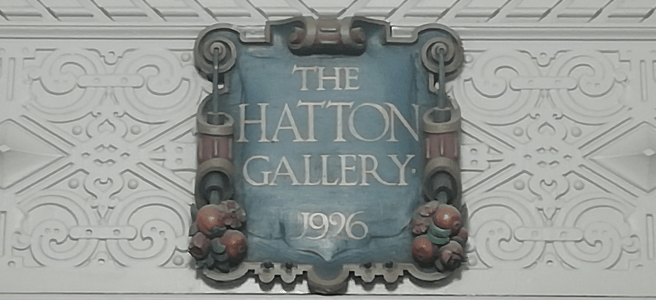
In 2015 I was very fortunate to start a PhD at Newcastle University, in collaboration with the University’s Hatton Gallery, researching aspects of the Hatton Gallery Collection.
My focus was on a significant collection of old master and contemporary artworks acquired by Professor Lawrence Gowing (1918-1991) for the Fine Art School in the 1950s that were intended to be hung on permanent display in the Hatton Gallery. In order to understand the environment that enabled Gowing to undertake such an endeavour I looked back at the Art School’s earlier history, from its origins in the formation of an art class in 1837 and its evolution through the Government’s Branch Schools of Design system, into the university Fine Art Department of Armstrong College and subsequently King’s College, Durham; which by the mid-1920s had become the first in England to be granted degree awarding status for its courses in fine art practice.
The person who guided the Art School through the turn of the 20th century, its move into its current, purpose-built King Edward VII building and the establishment of its fine art degree courses, was Richard George Hatton, Durham University’s first Professor of Fine Art.
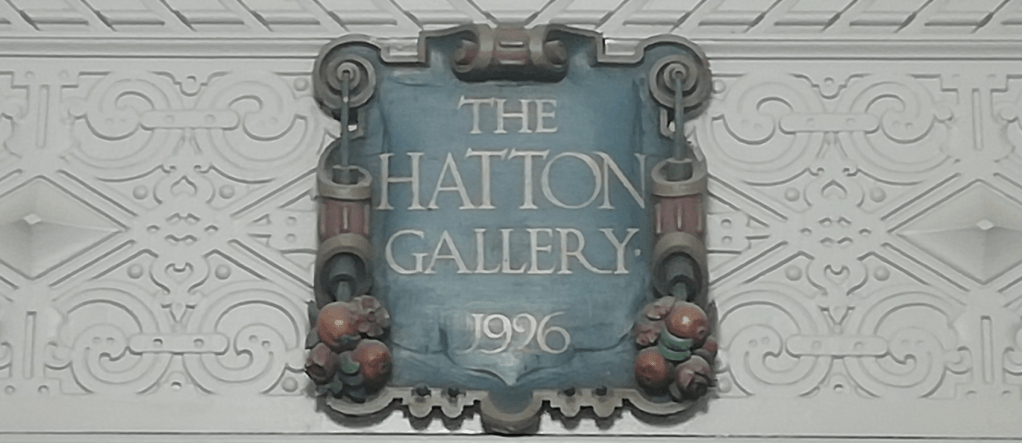
Hatton’s name is memorialised with a plaque bearing the date 1926, hanging above what, at that time, was the entrance to the classical-columned one room gallery. As I began to learn more about Hatton’s role in the Art School’s development, I was intrigued that, a century later, despite his presence in the name of the Hatton Gallery, there seemed to be little other acknowledgement of his achievements or his life. This prompted me to continue my research on Hatton once I had completed my PhD, starting at the point of Hatton’s death a century ago, in February 1926.
It seemed fitting that on the centenary of his death aspects of Richard Hatton’s life and work should be recognised over the course of this year’s Friends of the Hatton bulletins. This first article sets out some of what I have learned of the person who a former student, writing an appreciation of him in the Newcastle Daily Journal of 24 February 1926, described as “a great little man”.
Hatton’s death on 19 February 1926, aged 61, at his home Betley, in Elmfield Road, Gosforth was announced by the Newcastle Daily Chronicle the following day. It reported that the Art School had closed for the day, and the annual upcoming Art Ball had been cancelled. On 24 February the Daily Journal reported on Hatton’s funeral the previous day, stating that Armstrong College closed “as an outward sign of the great sorrow which had been cast over it by the death of Professor Richard George Hatton (Master of Arts, Dunelm), Honorary Associate of the Royal College of Art, highly esteemed Professor of Fine Art and Director of King Edward VII School of Art”. The funeral at St Andrews Cemetery, Jesmond, was attended “by the entire staff of professors and lecturers, dressed in their academic robes” together with students, alongside a long list of representatives from the region’s art institutions, educational bodies, clubs, societies, dioceses and trades, including the Laing Art Gallery, the Pen and Palette Club, the Bewick Society and the Society of Antiquaries.
Richard Hatton however began his life in Birmingham, born there in 1864. He went on to study at the Birmingham Art School, where, according to his Daily Chronicle obituary, he was a “keen and industrious student”. At seventeen, in the 1881 census he was described as an “Artist Painter of Figures”, living with his parents in Edgbaston. In 1885, aged around twenty-one, he became a member of staff of the recently opened building for Birmingham’s Municipal School of Art. He taught elementary modelling at its Central School but in the following two years he also became head of two of the city’s branch schools. In 1888 he successfully asked for an assistant in response to a marked increase in student numbers at one of the schools, possibly indicating the popularity of his classes and teaching methods. Under the management of the Birmingham City Fathers who were keen advocates of design and craft education and with William Morris as its president, the Birmingham Art School was gaining an increasing reputation as one of the country’s most progressive schools and was being held in regard as the centre of the Arts and Crafts Movement in England.
Hatton’s Daily Chronicle obituary explained that, as an art master at the Birmingham Art School, he “made rapid strides and was intimately associated with Rosetti, William Morris and Burne Jones”. These men were all closely associated with the Pre- Raphaelite Brotherhood and the Arts and Crafts Movement; they also had connections with Newcastle’s cultural life through their association with William Bell Scott (1811-1890), who had been the Newcastle Branch School of Design’s first Headmaster in the 1840s through to his retirement in 1864. Hatton, by his mid-twenties was, therefore, clearly moving in the same circles as the movers and shakers of the contemporary art world and had gained a considerable reputation as a teacher at the Birmingham School, all of which was to have an important influence on his future career. Birmingham Art School may have also played a significant role in Hatton’s personal life, as it is probably where he met his future wife Gertrude Helen Young (also born in 1864), who, at the age of 27, in 1891, was living in Handsworth and was a “teacher of drawing”.
Meanwhile, in Newcastle, by the 1880s the Art School had already undergone several transitions, from its beginnings as the art class of The North of England Society for the Promotion of the Fine Arts, through both a Government Branch School of Design and a provincial school of art under William Bell Scott. In 1864 Scott was succeeded by William Cosens Way (1833-1905) at a time when the art school was operating from rooms in Westgate Road, behind the Literary and Philosophical Society.
By 1890 the Art School had become part of the College of Science of Durham University, based in temporary accommodation in its grounds, somewhere on the current Newcastle University campus. The Art School Committee tasked Cosens Way to recommend someone to fill the vacancy of second master and in July 1890 Hatton was introduced to them and showed his work. He was offered the appointment at his requested stipend of £150 per year (possibly now around £24,000), with efforts made to find an extra amount to add to this sum. The Art Committee chairman at this time was James Leathart (1820-1895), a patron of the Pre-Raphaelites encouraged in his collecting by the Art School’s former art master William Bell Scott. Another committee member was the shipbuilder and art patron Dr Charles Mitchell (1820-1895) who had commissioned the building of St George’s Church, Jesmond in the Arts and Crafts style, another factor that may have contributed favourably to Hatton’s appointment. And so, in 1890, from the Arts and Crafts environment of the Birmingham Municipal Art School, Hatton, aged twenty-seven, made his way to a new life in Newcastle. In 1891 he was boarding at 18, St Thomas’ Crescent, just a short walk from where he was teaching, and in the following year he married Gertude.
The Fine Art Department that Hatton joined offered lessons in drawing and painting from life, figure modelling from the antique and from life, and in ornamental, decorative, figure and architectural design. Cosens Way delivered the lectures in anatomy, geometry and perspective and Hatton delivered them in all the design disciplines. The range of lectures and the topics he covered, from figure drawing to the design of rain spouts indicates Hatton’s breadth of knowledge and, it would seem, his stamina in acquiring it and delivering it to his students, who were examined for college certificates. If the students conformed to the required standards of the National Course of Instruction, they would submit their work for the national Department of Science and Art examinations and medals, for which the School earned payment by results, another pressure under which Hatton, his fellow teachers and his students would have operated.
In 1893 the College of Science provided its Art Department with its first purpose-designed, more spacious accommodation in its newly completed South West Wing (now the part of Newcastle University’s Armstrong Building which faces its Bedson Building). This movecoincided with or prompted its reorganisation on the recommendations of the College’s Principal, Dr William Garnett (1850-1932), whose aim was to create the best university college in the country. It was fortunate for the Art Department that although Garnett’s own specialisms were physics and mechanics, he had the vision to regard art education as an integral part of that ambition. Possibly encouraged by Hatton’s own experience of the Birmingham Art School system, it was put forward as a potential model. Following a visit there in 1894 by Dr Charles Mitchell, now the Art Committee chairman, and subsequent recommendations by Birmingham’s headmaster, the Art Department’s 1894-1895 prospectus was published under the heading, “Fine Art, Decorative Art and Art Technology”.
On William Cosens Way’s retirement in 1895, Hatton was appointed Art Master,initially for a year, but it seems no surprise that, with his obvious dedication to the Art School and art education, Hatton was re-appointed the following year, with an increased salary. By this time, too, an assistant teacher, Ralph Bullock (1867-1949), had been appointed.
On the death of Dr Mitchell his son, Charles William Mitchell (1854-1903), a Parisian-trained artist whose painting, Hypatia, is in the Laing Art Gallery, became the Art Committee’s new chairman. He had a passionate interest in supporting the fine arts and crafts and so with Mitchell as the Art Committee’s chairman and Hatton as its head master, the Art School moved towards the twentieth century with a distinctly Arts and Crafts character.
Hatton, meanwhile was also, evidently, giving a great deal of thought to his lectures and his teaching methods, being aware of the limitations dictated by a national examination system that meant more time was allocated to design theory delivered through lectures than was allowed for the students to develop their practice. Hatton’s solution was to produce a Text-Book of Elementary Design, published in 1894, intended to replace the students’ weekly lectures so that all their time could be dedicated to their practice, with relevant assistance given when needed. This textbook seems to have soon been widely adopted around the country as one copy was presented to a student at Hereford School of Science, Art and Technical Instruction soon after it was published. Another, in 1896, originally belonged to “Elizabeth Davies, Jarrow” of the “School of Art, Durham College of Science”. Davies was a prizewinning student who went on to teach at the Art School and played a significant role in Newcastle’s artistic culture. She and her two other gifted artist sisters, Louise and Barbara, went on to run a Fine Art Studio in Claremont Buildings, Barras Bridge, into the 1930s.
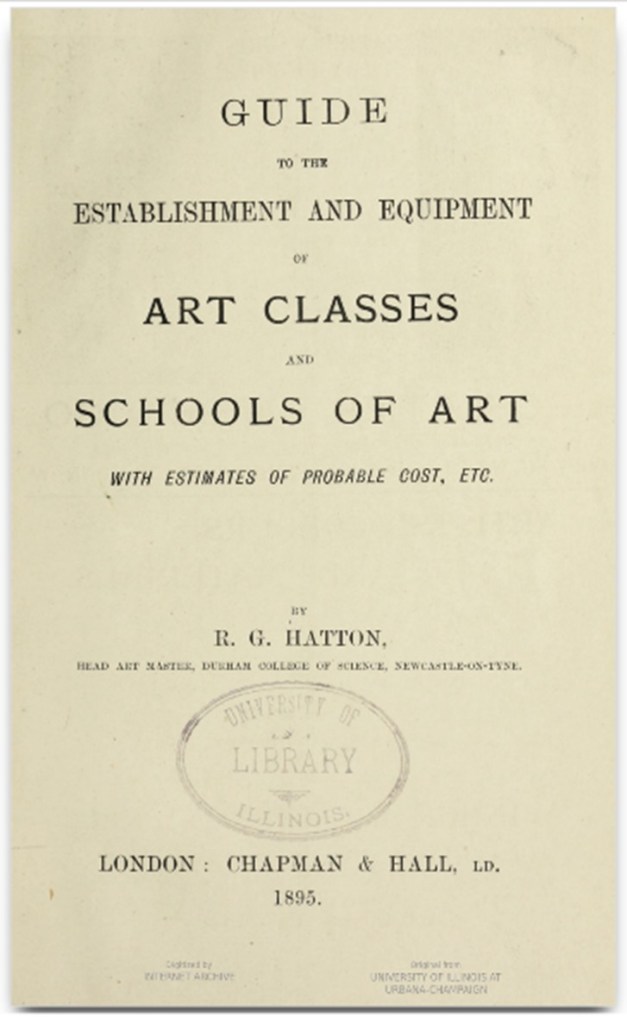
By the end of the following year Hatton had not only produced his next textbook Figure Drawing and Composition,he had also produced A Guide to the Establishment and Equipment of Art Classes and Schools of Art, which set out his suggested minimum requirements for an art school, indicating that he had either been significantly involved in planning the new facilitiesin the College of Science or was writing from his own experience of the drawbacks in its provision. In the list of apparatus, for example, he included a new “Horizontal Ruler” that he had invented to attach to a blackboard to replace the inadequacy of the “ordinary T-Square”.
Hatton was also building links with local manufacturers such as the pottery company C T Malingto promote the Art Department’s courses as sources of training to improve the skills of the local workforce and his students’ prospects as potential employees. Both he and Charles Mitchell were also aware of the lack of space available for students to develop their practical craft skills and the lack of opportunities for them to earn a livelihood from their limited training. As a result, in 1899, Mitchell founded and funded the Handicrafts Companyand, by special agreement with the Art Committee, appointed Hatton to spend half of his college time managing it for three years, extended beyond Mitchell’s early death in 1903, for a further three years. Hatton and Mitchell were also involved in setting up the county-wide Northumberland Handicraft Guild. By providing craftsmen and women in the North East with the opportunity to regularly exhibit their work and earn an income from sales and commissions these were important endeavours in supporting the development of the Arts and Crafts Movement in the region.
The first decade of the twentieth century was an extremely busy time for Hatton. He was overseeing the expanding Art Department of the College of Science, which in 1904 became Armstrong College, University of Durham. He was also running the Handicrafts Company, designing and making work for its commissions, publishing more books and travelling around the country’s art schools to produce a report for the Art Committee on arts and crafts and design education. Nevertheless, Hatton may have felt that he needed new challenges, for in 1908 he applied to be the first principal of the newly formed Edinburgh College of Art. It may have been a considerable relief to the Art Committee that he was unsuccessful,but it may have set them thinking about his status within the University, fearful of any other opportunities which might draw him away from Newcastle.
In 1911 Hatton’s contribution to art education was recognised nationally when he was appointed to the Board of Education’s Standing Committee of Advice for Education through Art. He would have also been planning and overseeing yet another move of the Art Department, into the larger, purpose-built accommodation of the King Edward VII School of Art, made possible by the generous donation of the mining engineer, John Bell Simpson.
By the time that the foundation stone of the new building was laid in April 1911, the Art Committee had decided that the Art Department’s headmaster should have the status of director. The Committee and Hatton were also drawing up plans for a three-year course for Diplomas in Fine Art and in Handicraft that required passing an entrance examination in English and a modern foreign language, alevel of academic attainment not needed for its part-time and certificate-level classes. And so, when the King Edward VII School of Art opened in 1912, in its prominent position on the college campus, it was a university art department with its own Director, art gallery and library, teaching classes in painting, crafts, engraving, sculpture and architectureand offering students the opportunity to gain entry to full-time diploma level studies. The Art Department had hardly, however, settled in its new building when it had to move out again to make way for the 1st Northern General Hospital at the onset of the 1914-1918 War. Hatton had to manage the move and provision of its classes again, to temporary locations scattered around Newcastle, as staff and students went into war service.
After the war and back in its new building, the Art Department continued to establish itself as a university department with its advanced courses in Fine Art, Design and Architecture. In 1917 the Durham University authorities set up the Chair in Fine Artand appointed Hatton as its holder and its first Professor of Fine Art, one of only a few people at that time to have held the post of Professor of Fine Art in an English university in a role which oversaw the teaching of painting, sculpture and design-related subjects, the others being the Slade Professors at University College London.
By this time Hatton and the Art Committee had also set their sights on their students having access to the university’s Bachelor of Arts degrees courses and after the end of the wartime disruption they could again focus on developing the curriculum to meet the standards required for degree-awarding status. All Hatton’s hard work and planning came to fruition in 1923, when the University Senate adopted Fine Art – Painting, Sculpture, Engraving, Architecture and Crafts and Manufactures, as a subject on the Bachelor of Arts pass degree course and Fine Art and Architecture as major subjects in the Honours Bachelor of Arts course, so that they were now acknowledged as disciplines supported by levels of research and scholarship worthy of degree status.
Sadly, with his death in February 1926, Hatton did not live to celebrate the results of his labours when the award of Durham University’s first Fine Art Honours Degree was made, in 1927, to Ethel Urquhart – that milestone was to be experienced by his successor, Edward O’Rorke Dickey (1894-1977).
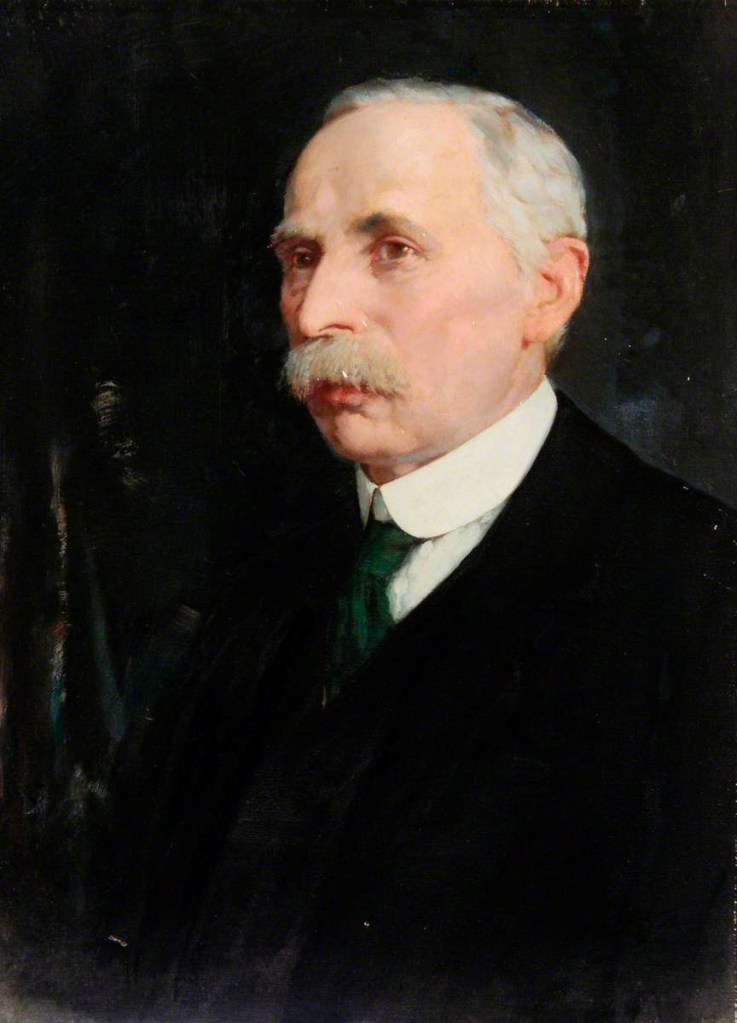
In the ensuing months of 1926, the Art Committee decided to rename the Art Department’s gallery the Hatton Gallery, commemorate it with a plaque and commission his portrait. However, over time, as Fine Art has become an established and accepted discipline in higher education and successive professors have directed the course of the Fine Art Department and made their own mark, Hatton’s achievements somewhat faded into obscurity, as did any evidence of a portrait. However, it was the work of Hatton, with the support of the enlightened Art Committee that, at the turn of the twentieth century, created the environment for development and innovation in art education and practice that laid the groundwork for the Fine Art Department’s success in future years.
Over the course of following issues of this bulletin, I will explore some of Richard Hatton’s work as an artist, his contributions to the development of the Hatton Gallery Collection and the rediscovery of the portrait that accompanies this article.
Further reading
Richard Hatton’s publications. -Many of Hatton’s textbooks can be found on the internet and copies are held in Newcastle University Library. His Guide on the Equipment of Art Schools can be viewed on the internet – Hathi Trust , http://hdl.handle.net/2027/uiuo.ark:/13960/t7pp44c3c
Hatton and The Handicrafts Company – Peart, Tony and Moat, Neil (1993), The lost art workers of Tyneside: Richard George Hatton and the (Newcastle) Handicrafts Company. The Journal of The Decorative Arts Society 1850 to the Present, 17, pp. 13-22.
Dr Melanie Stephenson
 Friends of the Hatton