

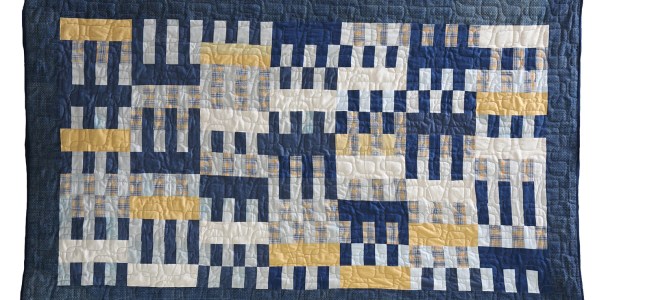
Our Featured Friend is Maggie Bassendine. Maggie has been a member of the Friends for over 40 years. She is currently planning an exhibition of her late husband’s work in his native Australia.
Please tell us a little bit about yourself and your interest in art…
I have been a long-standing Friend of the Hatton (FotH), since I moved to Newcastle in the early 1980s to take up a medical academic post at the University and, after more than four decades, I am now retired/ Emeritus Professor of Hepatology (= liver disease). I have always found art to be a good counterbalance to the stresses of a medical career, both as a maker and viewer. As a maker I now focus on textiles and as a consumer, I have a particular interest in 20th century British art, so the Hatton Gallery collection and the importance of the Department of Fine Art in post WW2 art education is a perfect match.
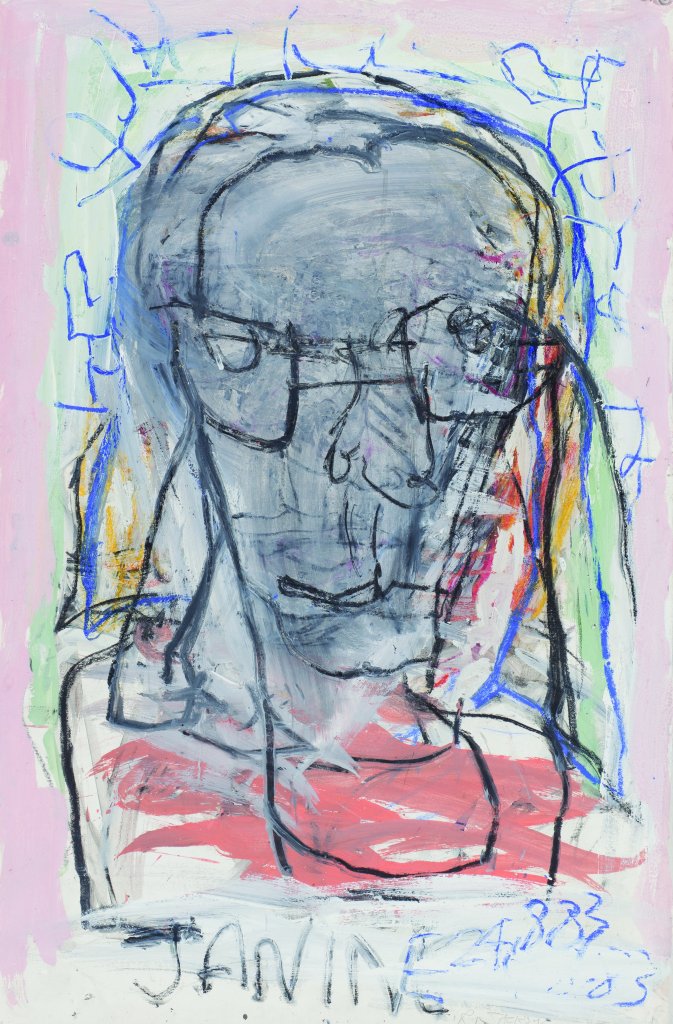
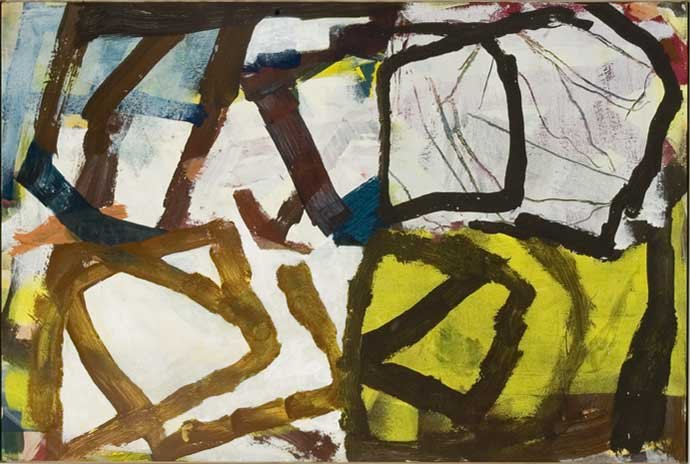
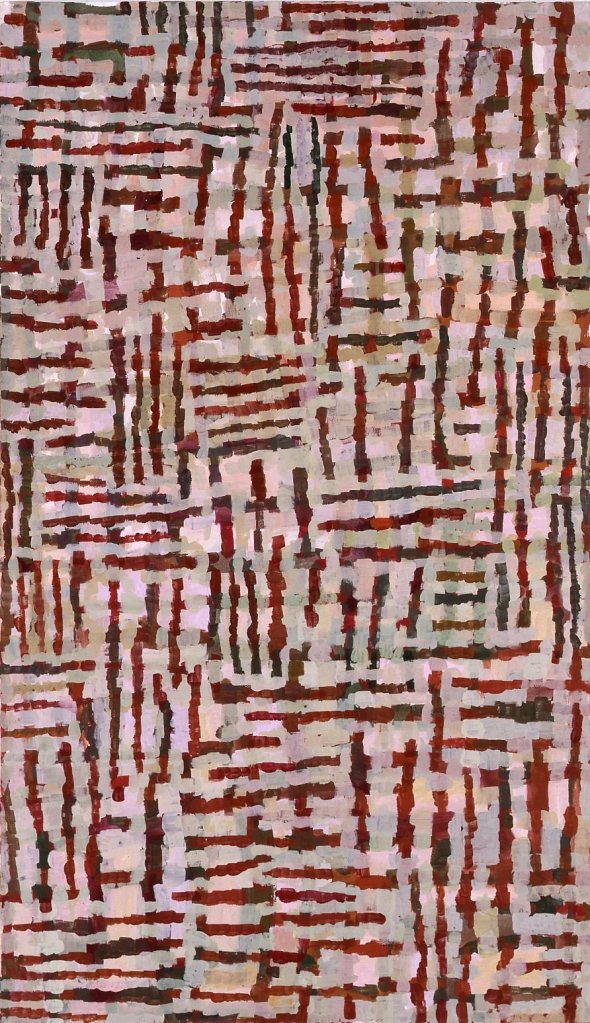
What are you currently working on?
I am currently working as Trustee of the Art Estate of my late partner, Roy Jackson (1944 – 2013), a British Australian artist [see Wikipedia entry & www.royjacksonartist.com], which is based in Australia.
I met Roy in the remote Cape York Peninsula in 1994 after viewing a job I was offered at the Queensland Institute for Medical Research in Brisbane. Roy, who was based outside Sydney, travelled to ‘Jowalbinna’ bush camp near Laura over several winters in the early-mid 1990s to immerse himself in the landscape and paint. Jowalbinna encompasses an extensive area of ancient Quinkan rock art (some >30,000 years old) which was ‘rediscovered’ by Percy Trezise (1923 – 2005) after the Palmer River gold rush had virtually annihilated the local indigenous people (1).
From 1995 Roy divided his time between Australia and the UK. He established a studio in Northumberland and, after he died in 2013, there was a Retrospective of his work in Australia. It opened in Canberra and toured to Sydney, then regional galleries in NSW (Wollongong, Maitland, Orange & Tamworth) and was accompanied by a monograph (2).
I’m currently planning an exhibition, at The Defiance Gallery, a commercial gallery in Sydney. The concept of DECA: it’s both a decade since he died, and a decade of work related to his travels in Oz along the ‘Mereenie Loop’, a dirt road in central Australia which we travelled together.
After Roy’s premature death I focussed on ‘weaving the grieving’ and have made a number of memory quilts inspired by the work of Gee’s Bend (3) and Anni Albers (4) incorporating my weaving using his clothes and patchwork e.g. ‘memory quilt III’ (see cover). I am passionate about reusing and recycling materials.
Upcoming events/exhibitions:
I am really looking forward to visiting two abstract art exhibitions: One at the Hatton Gallery ‘Wilhelmina Barns-Graham: Paths to Abstraction’ which is supported by the Wilhelmina Barns-Graham Trust, based in Scotland [see http://www.barns-grahamtrust.org.uk/%5D
The other at the Royal Academy in London – ‘Souls Grown Deep like the Rivers’. It is supported by the Souls Grown Deep Foundation [see www.souwindowslsgrowndeep.org ] and will include some Gee’s Bend quilts, hailed by the New York Times as “some of the most miraculous works of modern art that America has produced”.
Favourite part of being a Friend of the Hatton
Meeting like-minded people and enjoying the redeveloped space – it is a fantastic gallery after the 3.8 million refurbishment which was completed in 2017. As a Friend I hope to do my small bit to support the Hatton Gallery and perhaps help to move it forward into a new era.
Musings
I would like to see the Hatton Gallery play to its strengths and aspire to be the Pallant House Gallery of the North. This gallery in Chichester describes itself as a leading UK museum that stimulates new ways of thinking about Modern British art from 1900 to now. As the art gallery of Newcastle University, the Hatton should be in a unique position to pursue studies in British Art and collaborate with centres of excellence overseas such as the Paul Mellon Centre at Yale University in the US and the Drill Hall Gallery at the Australian National University.
It is unclear to me whether the decision by the University authorities to pass the management of the Hatton Gallery to Tyne and Wear Archives and Museums, has been all positive or whether aspects of the link should be re-addressed. I witnessed the decision to close the gallery in 1997 and its rescue by Dame Catherine Cookson, so I am aware that decisions may need to be reviewed.
- Conspiracy of Silence: Queensland’s Frontier Killing Times, Timothy Bottoms ISBN 978 1 74331 382 4
- Roy Jackson hands on ISBN 978-0-9874380-8-9
- Gee’s Bend: The Architecture of the Quilt by Paul Arnett ISBN 10: 0971910456
- Anni Albers: On Weaving ISBN: 9780691177854
 Friends of the Hatton