

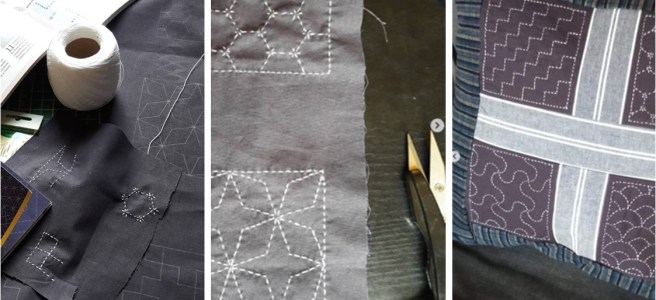
The Workshop “Japanese ‘Mindful’ stitching” lead by Jo Duncan did require a good amount of concentration. We made two lovely books, binding loose sheets together. The first was relatively simple, but the second more decorative and requiring careful consideration. The stitched pattern magically appeared on both sides of the binding.
Jo could not have been more helpful providing everything we needed with full instructions for every stitch. She patiently retraced our mistakes and unravelled our tangled thread. We also had time to make an unusual book mark in Sashiko stitch
I am sure Jo’s enthusiasm for her subject sent many of us off to look for further stitching designs and to understand the benefits of crafting to improve mental health.
Follow Jo’s creative journey on Instagram (@merryshrew2) or Facebook at Of Threads and Patches.
Marion Thompson
Although I have made a few items using the Sashiko stitching in the past, I find it is always useful to learn new techniques, with like-minded people. Most of us completed a cherry blossom bookmark, which was very pretty.
The stab binding totally befuddled me, especially when I transferred the design upside down; well I guess there has to be one, who misinterprets the instructions. Not perturbed Jo very kindly let me have some further paper and even punched new holes for me. It did start well, but very soon my thread decided to knot itself. I did get quite frustrated with it, and packed it away. I am pleased to report I have now completed it. I have even been inspired to look up further patterns of Stab Binding on the internet. Other participants in the workshop achieved success while they were at the gallery. Jo very kindly provided us with all the materials required. We all had a fun afternoon.
Vivien Jackson
I took a course in bookbinding when I was a student in the early 1990s and have been fascinated by book construction ever since, so I was immediately interested when I saw Jo’s Japanese Stab Binding workshop advertised.
Jo provided all the materials along with tools and step by step instructions and templates for two small stab bound books. We started off with a simple 4 hole design and then onto a more complicated design with 37 holes which resulted in a repeated lotus flower design. The stitching process in stab bound designs is very methodical and creates the same design on the back as the front of the book; I have no idea how these complicated stitch patterns are conceived and developed, but they look fantastic when they’re finished. Guess what everyone’s getting for Christmas!
Roger Newbrook
 Friends of the Hatton