

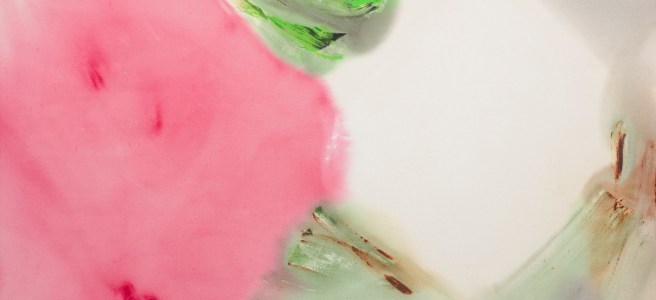
The late Phyllida Barlow spoke of Mali Morris as having ‘extraordinary power as an artist of great authenticity and profound creativity’.
Morris cites her influences as many and varied; studying in Newcastle’s Fine Art department in the 1960s, she valued the studio teaching of Rita Donagh and later became friends with painter Ian Stephenson, with whose ambitious abstract paintings she felt an affinity. She wrote her dissertation on Gian Domenico Tiepolo, travelling to see his frescos at the Villa Valmarana ai Nani at Vicenza, and speaks of a continued connection to the work of modern giants: Matisse, (‘so radical’), the lightness and colour of Cezanne (‘you never get to the end of Cezanne’}, and the colour fields of Helen Frankenthaler. Morris also talks of the joy and wonder of nature – how things grow and become what they are and of childhood memories, of walking up Snowdon by moonlight in order to reach the summit to see the breaking dawn.
It should have been no surprise, then, when visiting Morris in her studio, that her working space sits between two bodies of water in the heart of south east London, where the light is ever-changing, charged, moving with the tidal water. Morris’ paintings are noted for their luminosity and translucence and fresh, vibrant colour, colours, shapes and forms moving effortlessly together gently pushing and pulling across the layers of space in which they dance under the viewer’s gaze – there I sat, surrounded by the dance of colour and light and remember thinking – how perfect!
Mali Morris: Returning at the Hatton will feature around 40 key works spanning 45 years, tracing the evolution of Morris’ painting from the early gestural and stained pieces into the vivid geometric layering of recent work
Mali Morris: Returning is co-curated by Sam Cornish and Zoe Allen.
 Friends of the Hatton