

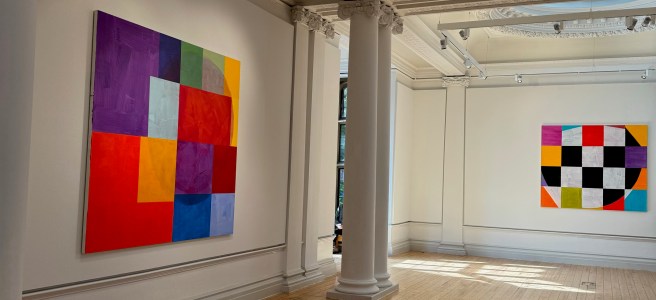
This exhibition (which runs until 11 January 2025) marks the return of Mali Morris to a city that holds a special place in her heart and one where her artistic career began. Arriving from North Wales as a student in 1963, Newcastle, with its wide streets and high-rise bridges, seemed dramatic and different. The whole country was emerging from post-war austerity, and in Newcastle there was a noticeable buzz and a visceral mood for change. There were drastic architectural transformations, as well as the excitement of the latest fashions, art, music, and poetry. The city itself was hugely influential on Morris – seeing bands at the Club a‘Gogo, concerts by Bob Dylan and the Rolling Stones, and hearing new poetry at the Morden Tower, where Alan Ginsberg performed, and Basil Bunting gave his first reading of Briggflatts.


It was a critical moment at the art school, too, where big changes had recently been introduced. Newcastle University had just that year become independent. Artists and educators Victor Pasmore and Richard Hamilton had developed a new and radical first-year Basic Course with ideas stimulated by the Bauhaus, that would go on to change how art education was taught in Britain. Rather than a classical art training where students copied static objects, it was a more dynamic programme of exercises in how to think critically about forms and pictorial structures. Hamilton’s teaching brought in external influences from the contemporary world, such as advertising, cinema, literature, science and the art scene in New York, and with Professor Kenneth Rowntree’s approval, he invited in significant British artists, for visits. One such was Terry Frost, who ran a colour project. What Morris learnt from Frost was “Colour as entity, not adornment or description, not as decoration, but as a structural force … it had everything to do with the world, but without having to describe it.”[1] Other eminent artists she encountered at the Department of Fine Art were Matt Rugg, Rita Donagh, Ian Stephenson, Derek Morris, Eduardo Paolozzi, Joe Tilson, Richard Smith and Sandra Blow. All had an impact on her experience, informed her understanding or offered her encouragement, helping her build her own unique practice-led enquiry that would sustain her for the rest of her career. Her years at the University were certainly formative and provided innumerable influences. For Morris, the “lasting legacy of Fine Art at Newcastle is a tendency to be analytical about what constitutes painting, without denying its seductions, and its ability to move one.”[2]
Dr Harriet Sutcliffe
[1] Mali Morris, Mali Morris: Painting (London Royal Academy of Arts 2019), 118.
2 Mali Morris, interview with Harriet Sutcliffe (July 1, 2024)
 Friends of the Hatton